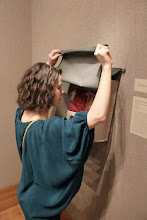
Bryn McConnell at her studio. Photo by Rena Silverman.

Bryn McConnell’s studio door is decorated with a clean grid of inspirations. One piece of construction paper reads, Everything is an experiment, while Art ‡ Democracy, Kunst ‡ Kultur, ART = Humpty Dumpty, ART = YUMMY YUMMY—the words of the German painter Jonathan Meese—mark a small poster. There are fashion ads and post-its, a magazine tear-out of the choreographer Trisha Brown, and just above the door’s handle a small white paper that says, go too far and get messy. On the right, a long, narrow white desk holds a diet coke can, an iPhone, a desk lamp, a bottle of Advil, clear glasses, a copy of John Richardson’s Life of Picasso, The Cubist Rebel, and the wings of an open magazine. Across the SoHo studio—which can’t be more than 300 square feet—two large canvases of brightly colored figures hang from a low ceiling and dominate the room like a pair of eyes.
Bryn McConnell just had her first solo exhibition at the Frontrunner Gallery in early February.Titled Looked, the exhibition featured six paintings of iconic women, each of which McConnell made in the last two years. Linear brushstrokes dipped in vivid colors zigzag about in short rhythmic motions, just barely coming together to form the figures and faces that dominate the frame. Five out of six of these paintings were taken from her Re: self-reflection/refraction/reflexion series.
“These paintings struggle, with grace, to combine the sometime conflicting worlds of the individual’s exterior and interior,” writes McConnell in the exhibition’s press release. “The Form vs. The Formless. The Conscious vs. The Unconscious. The Seen vs. The Unseen. The Identity vs. The Spirit. It’s a battle with the self, in varying degrees of pretty brutality.”
McConnell’s exhibition opened just weeks after Willem de Kooning’s retrospective closed at the Museum of Modern Art, where a whole other set of six women hung in the center of the museum’s 17,000 square foot exhibition. De Kooning’s women started off as figures blending into backgrounds of abstraction and later became what Artinfo recently described as, “a tornado of paint barely contained by the picture frame.”
McConnell, on the other hand, uses Impressionist strokes and a Fauvist palette1 to create female figures who thrive in individual environments. Willem de Kooning curved, swished, and attacked his canvas with heavy brushstrokes of oil paint (“Flesh was the reason oil paint was invented,” he once said, famously). McConnell chops, turns, and leaps across her canvas with the lighter lines of acrylic paint (in a 2010 Blog entry about Georgia O’Keeffe, McConnell wrote, “I curse whoever introduced [O’Keeffe] to oil.”)But—like De Kooning—McConnell can paint a ferocious eye.
Take, Re: Les Demoiselles de Miroir, for example. Here, a woman walks towards us, leaving two sharp reflections behind her. A pale green diagonal line runs down her face, highlighting one harsh, visible eye (the other is fashionably concealed by the dip of her hat). With a piercing gaze, she looks more at us than we do at her. Cold, confident, and draped in royal purple, the woman nearly breaks through the facade of the frame with her gaze.
The title of McConnell’s painting is just one of five that incorporates contemporary communication (“Re:” referencing the subject line of an email reply), but this one also alludes to Picasso’s Les Demoiselles d’Avignon (1907). Scholars consider this painting, which features five nudes in a brothel—four standing, three masked—the “first exorcism painting.2“Perhaps McConnell’s clever spoof on the title for her own painting, Re: Les Demoiselles de Miroir (Re:The Young Ladies of the Mirror), suggests that a mirror can be just as threatening for a woman as a brothel.
In Re: Narcissister, a woman, presumably seated (although her legs are not in the frame)—with her back straight up against the right edge—bows her head over a large, round mirror, like a wilted flower. Drawn first to the top where her profile lingers, our eyes follow the woman’s gaze down a single trail of thin green paint, which dips into the mirror, revealing a full view of the woman’s face. Here, two bright aquamarine eyes pop, consuming us. We find ourselves devoured by the woman’s reflection, just as she too is by her own. Reds, blues, greens, and alternating streaks of white and black form the fabrics and hair of this woman. The background is a dark deviation from the incorporated palette of Les Fauves and the Impressionist strokes.
In Re: Self-Rejection, a woman is lying down on a bed of ribbed red, knees bent to the side, hair and head thrust to the back. Two dark high heels are the closest thing to our point of view. Perhaps she is somewhere tropical, or maybe on a roof of a Manhattan apartment, or far away in the South of France. We do not see her face, only her body, which, shaped like a receding figure-five, folds backwards into an expression of pain.
Re: Odalisque is what the title suggests, but in vibrant yellows and fiery reds. The “odalisque”—historically the lowest form of a female slave in a harem, often the sultan of Turkey—began as a fantasy subject in the erotic paintings of Orientalism, but became the widely adopted subject matter of 19th and 20th century French artists, most famously Matisse, who arranged an “Oriental” alcove for inspiration.3
The largest painting and perhaps central force of McConnell’s exhibition, titled, Weight, is the only painting taken from her 2010 series, DELETE, in which she chose to obliterate figures with “slash-like” brush strokes. This distinguishable, white, 60×72 inch painting shows a woman lying down wearing nothing but boots, holding a bouquet of flowers.
Bryn McConnell was born just outside of Seattle, Washington to a political cartoonist father and a clinical psychologist mother. “I knew I would either be an artist or a psychologist,” says McConnell. She tried both at Western Washington University, but when it became apparent that art was the better route, she transferred to Pratt in New York. At the end of college, she’d fallen in love for the first time. She had discovered the work of Ree Morton. She gained confidence, and her paintings earned a more whimsical touch. After graduating, Bryn moved to the Czech Republic where she began her career as an artist. It was at this time in Prague that Bryn founded the concept that underlies her current exhibition. “Hiding behind a facade,” she says, “or a figure masked by fashion provided inspiration,” an idea she attributes to living in a foreign country and not knowing the language. McConnell says that she reconciled this problem by using appearance to “declare uniqueness,” in order to “socially present something on the inside.”
In 2008, McConnell returned to New York to earn her Masters at the School of Visual Arts. In 2010, she moved into her studio on Greenwich Street. One year later, McConnell was painting in her studio during an open studio tour, when Edward Symes, co-founder of the Frontrunner gallery in TriBeCa walked in. “We were extremely impressed with her work,” Symes says in a recent phone interview. “It fits in with what we are interested in, which is emerging artists who haven’t had solo show yet, people with a pretty clear social message.” He says. “If you start to look closely you see little hints that allow for a greater understanding of what is just beneath.”
For the closing exhibition party at the Frontrunner Gallery on a February 2nd, McConnell participated in a 13-minute staged piece with the Push Pops, a Bushwick-based performance group led by Katie Cercone and Elisa Garcia de la Huerta. According to their Go! Push Pops website, the Push Pops are a “radical, queer feminist art collective…geared towards engendering ‘Embodied Feminism’…[and] concerned with the expenditure and conservation of the self in relation to the Other.” Ms. Cercone and Ms. Garcia show this by adding a third libero member to vary each performance. On February 2nd, Bryn McConnell was that member.
“The main thing I could contribute [to the collective] would be my concept,” says McConnell, who originally described the group as “Feminist Dada,” one that in performance “usually ends up getting aggressive or somehow a little bit explosive.” The February performance took place against the back-drop of McConnell’s paintings. A triangle made of tape marked each of the girls’ places, where they walked out with scissors and chopped off pieces of each other’s clothes, drawing on each other’s faces with bright pink-red lipstick. At one point, McConnell, who was originally dressed in lacy black skirt, barely had more than a bra and rags on, while the other members had lipstick all over their faces. But somehow it worked. At times, the girls even looked like McConnell’s paintings had come to life.
Bryn McConnell lives in Hells Kitchen and aims for the 11pm-7am sleep schedule. In the mornings she goes to the studio; in the afternoons deals with the “computer stuff”. Yet, no matter what, she finds time to write for half an hour everyday, “Even when it is boring.” A habit learned from her “bible,” The Artist’s Way. “It is good for me to write about what I watch and experience,” she says. “It helps me understand what I am doing in my own work. “
In evenings, you can find her at the gym, spinning or yoga class: “I get really good ideas in spin class sometimes.” Sometimes, however, it’s just about doing nothing, an idea she learned from reading a profile on Marlene Dumas, the South-African born artist and painter who stressed the reality of limitation of the human body and the psychological value of doing nothing. “If I hammer out work day to day it just ends up looking like work,” says McConnell.
McConnell does not like to paint in front of others. Only once, while pursuing “Alice Neel-style” portraits of her friends, did she do it. “I am definitely extremely protective of my alone time to paint,” she says. “It is a heavy weight for me to be seen, which is probably why the content of my work deals with façade!” Lately, however, her curiosities have shifted from fashion-as-facade. “My interest of late is more with older women,” says Bryn, “Women whose power and strength, beauty and sexuality exudes even through faded and wrinkled flesh.”
McConnell, who has not been to her studio in over a month, worries that she will forget how to paint. At the same time, she says it isn’t worth getting too regimented. “Creativity is like looking at the sun, you can’t look at it directly,” she says. “I look instead where the light falls.”
1. King, Sally, interview by Rena Silverman, 27 January, 2011, New York, NY.
2. The Museum of Modern Art, MoMA Highlights, New York: The Museum of Modern Art, revised 2004, originally published 1999, p. 64.
3. Odalisque, The Concise Oxford Dictionary of Art Terms. by Michael Clarke and Deborah Clarke. Oxford University Press Inc. Oxford Reference Online. Oxford University Press. The New York Society Library. 12 February 2012.


BOMBlog
Bryn McConnell toys with color, line, expression, the canon—both on and off the canvas.